
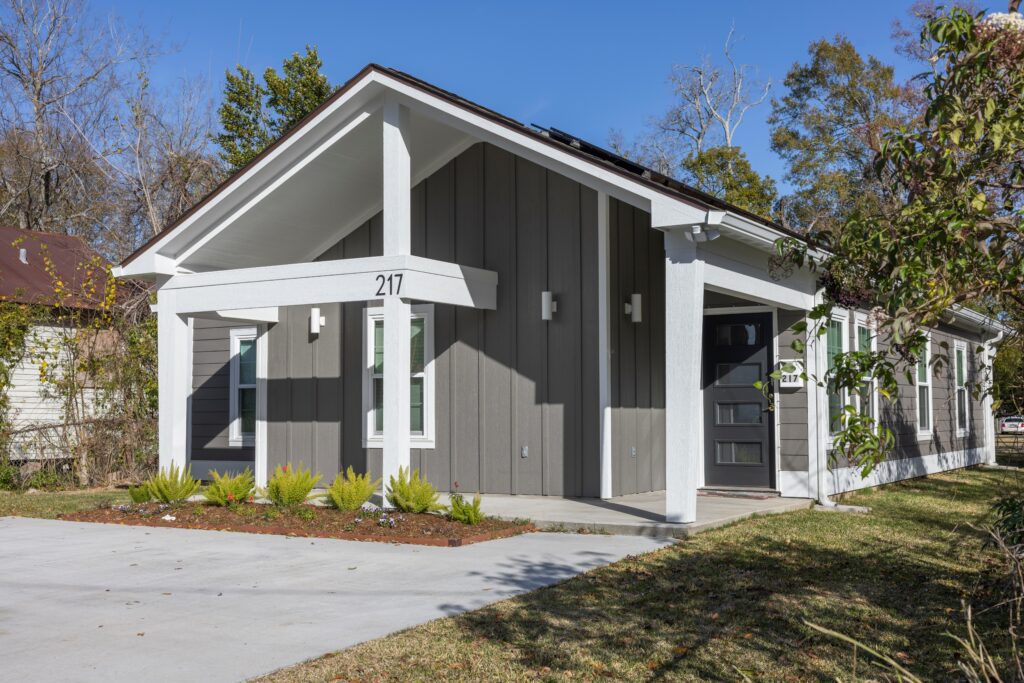
While home affordability has risen to the top of the national challenges list in recent years, Habitat for Humanity has been tackling the issue for nearly 50 years to benefit low-income families. Insulation Institute recently talked with Adrienne Goolsby, Habitat for Humanity’s senior vice president, U.S. and Canada, about the company’s builds and how it keeps the cost of ownership, not just home building, at the center of its operations.
Greater than Ever Need
Home prices are historically high compared with the median household income, surging to more than five times income this year, according to Harvard University’s Joint Center for Housing Studies.[1] Most Americans still agree that homeownership is foundational to living the American dream. Still, prospective home buyers, particularly Gen Zs, are becoming discouraged about their ability to ever own a home.[2] That’s what makes the need for Habitat for Humanity even greater today, in light of the affordability challenge.
“Habitat’s mission and work are needed more now than ever, as the housing crisis continues to deepen, increasingly pushing homeownership out of reach for many Americans,” Goolsby said. “Addressing this crisis is essential to strengthening communities and supporting economic growth, so we will continue to expand Habitat’s reach and impact through sustainable construction, improving systems and policies, and creating access to resources.”
Habitat funds the homes it builds through many revenue streams, including individual and corporate donations and grants. Another revenue stream comes from its nonprofit ReStore resale shop, which sells donated new and used goods, with the proceeds supporting local builds. Further, the company benefits from in-kind donations of building materials and appliances from manufacturers and relies on volunteer labor to cut building costs. But if you think cutting costs means also cutting corners, think again.
Creating A Better Home and Better Health For Families
Energy efficiency is at the core of the Habitat for Humanity homebuilding model because energy-efficient homes keep homeowners’ long-term costs low. Each Habitat home is built to a minimum ENERGY STAR for Homes standard, which requires enhanced insulation, air sealing, and more efficient mechanical systems than code-built homes. “Our affiliates use different construction methods when it comes to sustainable building, but some common practices also include using energy and water-efficient appliances, and some install solar panels to pursue net zero or LEED certifications.”
Habitat doesn’t just focus on energy performance. Building resilience is also at the center of its builds. “Habit makes sustainable building a priority around the world, and we work in concert with many partners to improve the quality of our homes and the building process,” Goolsby noted.
Required features for Habitat for Humanity Homes include impact-resistant roof designs, wind-rated shingles, and impact windows and shutters. Elevated foundations and flood-resistant materials are used in flood-prone zones, and structural reinforcement for earthquakes is incorporated where necessary. It’s an approach to smart, durable building that ensures homes weather storms well and remain habitable longer during outages, maintaining optimal indoor temperatures.
“Building healthy homes for Habitat includes using construction standards that focus on safety and health as well. This ensures that we are building to take better care of our environment, homeowners, and volunteers,” Goolsby said. “Our goals are to reduce the home’s life cycle costs and increase efficiency while providing healthy environments. We also know that healthier homes lead to healthier families. Where you live is directly linked to your physical and mental health, education, and economic trajectory. In short, home is foundational to so many aspects of our lives.”
Public Policy + Partnerships Can Lift Habitat Homeownership
Habitat for Humanity’s capacity to build homes is heavily influenced by public policy, financing, and strategic partnerships. Land is one of the organization’s biggest bottlenecks, and one way cities, counties, and states can help is by allocating surplus or unused public land to Habitat at low or no cost. Zoning reform to allow smaller lots and duplexes is another way to help fill the “missing middle” of the housing market.
“We know that Habit and other nonprofit developers cannot simply build our way out of this crisis. We need investment from the public and private sector, as well as policy changes that make it easier to build more homes in more communities,” Goolsby added. “Together, we can build brighter futures.”
[1] https://www.jchs.harvard.edu/blog/home-prices-surge-five-times-median-income-nearing-historic-highs
[2] https://www.scotsmanguide.com/news/two-thirds-of-gen-z-think-they-will-never-own-a-home/