
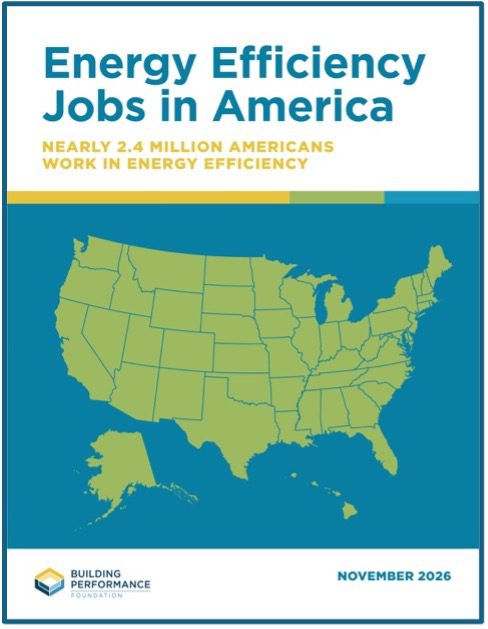
The Building Performance Foundation has published its 2026 Energy Efficiency Jobs in America report, which shows that after five years of job growth, energy efficiency (EE) employment declined by 0.9 percent in 2025, a loss of 21,441 jobs. The report largely attributes the loss to uncertainty about federal policy changes and market volatility.
The EE industry employed 2.36 million people last year, more than 25 percent of all workers in the energy sector. And although EE jobs declined overall, the sector remains the largest energy subsector in 39 states and the District of Columbia. These are also good-paying jobs. Wages in the sector grew 2.8 percent, double the national rate, and salaries run 18–23 percent higher than the national average.
The Details Behind the Data
BPA’s report draws on data from the U.S. Department of Energy’s 2026 U.S. Energy and Employment Report (USEER), which tracks employment specifically for the energy efficiency sector. The report focuses on the built environment and includes only jobs in which workers use ENERGY STAR energy-efficient products and high-performance building materials that reduce energy use.
Where Those Jobs Are
Nearly 1.3 million people in the U.S. work in EE construction, installation, and repair, making essential upgrades to homes, schools, hospitals, and other buildings. Contractors who install these products, such as insulation installers, remain a key source of jobs. However, EE construction employment fell by 11,900 workers last year.
While numbers are trending down in parts of the EE workforce, manufacturing is growing. EE production and manufacturing jobs grew 3 percent last year, adding about 10,000 workers. In states like Kentucky, Wisconsin, Alabama, and Mississippi, manufacturing makes up more than one-quarter of all EE employment. In Michigan, it makes up more than half.
Despite uncertainty around EE policy, demand for energy-efficient products remains strong, particularly since electricity prices rose 40 percent from 2020 to 2025 and utility gas prices rose more than 50 percent over the same period. With inflation hammering Americans at every turn, BPA notes that programs that tackle energy waste offer an excellent opportunity to save money while supporting local EE jobs.
Price Pressures Make EE Upgrades Attractive
With home energy costs top of mind for homeowners and prospective homebuyers alike, energy-efficient upgrades remain a popular choice. Homebuyers rank efficient windows (83 percent) and above-code insulation (72 percent) among essential or desirable features. And, according to a 2025 Consumer Reports survey, more than 80 percent of Americans favor government incentives such as tax credits (like the former 25C tax credit) and rebates (like the HOMES and HEEHR) to help pay for home energy-efficiency improvements.
Overall Outlook
Because building energy efficiency offers strong economic benefits, employment prospects remain good, particularly in building performance, electrification, energy infrastructure, industrial efficiency, utility programs, and building technology. However, uncertainty in the political environment, the overall economy, and the housing market could all affect future jobs.