
Millions of American households struggle with energy costs, yet those who could benefit most from home energy-efficiency improvements are often least able to afford them. A report from Harvard University’s Joint Center for Housing Studies (JCHS) highlights this disparity: lower-income homeowners are less likely to undertake energy-related improvements and spend less when they do, despite facing a greater energy burden.
Closing this retrofit gap requires more than help paying utility bills. It requires making energy-efficiency improvements accessible and affordable to the households that need them most.
The Affordability Gap
JCHS analysis of data from the U.S. Energy Information Administration’s 2024 Residential Energy Consumption Survey found that nearly 60% of households earning around $30,000 annually experience energy insecurity.
Yet homeowners earning less than $30,000 accounted for just 8.9 percent of energy-related remodeling expenditures in 2023. By comparison, households earning $150,000 or more accounted for nearly 40 percent of spending, despite representing only 9.9 percent of energy-insecure homeowners.
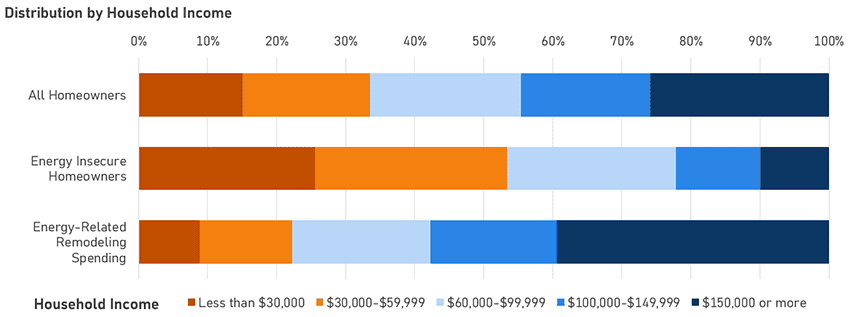
The disparity extends to individual spending. Lower-income homeowners spent an average of $6,100 on energy-related projects, compared with approximately $11,200 among households earning $150,000 or more. For homeowners earning less than $30,000, energy-related project expenditures represented 6.3 percent of income—nearly eight times the 0.8% share among the highest-income group.
These figures illustrate the challenge: homeowners facing the greatest energy burdens often lack the resources to make the improvements that could help reduce them.
Beyond Utility Bill Assistance
Many assistance programs help households manage energy bills but do little to address their homes’ underlying conditions. Insufficient insulation, air leakage, and inefficient equipment can drive up heating and cooling costs, leaving households vulnerable to ongoing energy expenses.
Home energy retrofits can help address these underlying problems. Federal funds available under the Inflation Reduction Act include funding for the Home Efficiency Rebates (HOMES) and Home Electrification and Appliance Rebates (HEAR) programs. Eligible improvements include insulation, air sealing, ventilation, and heat pumps, subject to program rules and applicable limits.
However, access to these incentives depends on implementation, eligibility, and fund availability, as states have already received their share and some have exhausted those dollars. A lasting solution must address not only the cost of improvements but also the practical barriers that prevent households from completing them.
Closing the Retrofit Gap
JCHS argues that investments in energy-related housing improvements can reduce energy insecurity more than bill assistance alone. Realizing that potential requires a more comprehensive, people-centered approach.
A successful retrofit strategy should make improvements affordable, connect homeowners with qualified contractors, simplify access to assistance, and prioritize measures that improve home performance and reduce energy use. Utilities, governments, contractors, and industry organizations all have a role.
More than 100 million homes have been identified in the original discussion as potential candidates for energy-efficiency and electrification upgrades. The challenge is ensuring low-income households aren’t left behind as the retrofit market grows.