Insulation Institute Blog

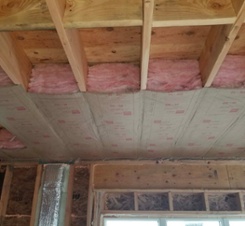
Building Tighter Homes with Gasketed Framing

If you follow our blog, you know that we talk quite a bit about building science. In fact, we wrote a primer on how builders can use building science to produce more durable, comfortable, and energy-efficient homes. We also share information on effective air sealing and blower door testing — a pain point for some builders having to meet new testing requirements of the 2012 and 2015 Residential IECC.

As any building scientist worth their salt will tell you, air tight homes start with great framing. Michael Schettine of AccuFrame Energy Seal isn’t a building scientist, but he has more than 45 years’ experience in home building, carpentry, and architectural reconstruction. His background has led him to believe that there’s a better way to reach air tightness targets, and it begins with a positive change in the way homes are framed.

Details »

Building Tighter Homes with Gasketed Framing

5 Podcasts for Builder Education On-The-Go

Time is a precious commodity and no one wants to waste it. Managing the day-to-day obstacles that confront builders can make it difficult to keep abreast of the business-building ideas and developments in areas such as consumer trends, technological advancements and new construction practices. While the Internet may have made information more accessible, it can be difficult to synthesize the volume of it, especially given the pressing priorities that consume work hours. Podcasts, digital audio files that can be downloaded to a computer or mobile device, give busy builders and building industry professionals an opportunity to get free, quick learning on-the-go —  at any time of the day in 30 – 45 minutes. Here are five practical, informative and business-building podcasts of note:

Details »
5 Podcasts for Builder Education On-The-Go

An Innovative Seal Tight, Frame Right Method

By Michael Schettine, Technical System Expert, AccuFrame

Roughly three-quarters of builders in U.S. states will soon have to comply with more stringent air tightness requirements of modern version of the IECC (either 2012/15 or 18). As builders seek to meet these requirements, they may be persuaded to believe that multiple and/or expensive products (like spray foam) are the only pathway to achieving the 3ACH 50 target. Testing conducted recently by The New York State Energy Research and Development Authority (NYSERDA) and a top U.S. research lab demonstrates that the 3ACH 50 blower door target can be met using an innovative air isolation management solution, that is not only effective, but less expensive than foam and doesn’t require evacuation of the trades.

Details »
An Innovative Seal Tight, Frame Right Method

A Custom Builder’s Approach to Economical, Energy Efficient Insulation

As both a green and custom home builder, Eddie Fort of PD & M Contractors has a client base that is affluent and knowledgeable about energy efficiency.  Fort, winner of the 2015 EarthCraft “Home of the Year,” award, builds shorefront properties in Smith Mountain Lake, Virginia, near the geographic center of the state and adjacent to Lynchburg.  At a price point of $750,000 and above, Eddie works closely with his clients to deliver a dream home that includes all the “bells and whistles” you expect with a custom home, which typically means “high end” everything. But for PD & M, delivering energy efficiency and quality doesn’t have to come at a super premium price. In fact, the company insists on spending its client’s money wisely. One area where they achieve that goal is through using hybrid insulation systems – particularly “flash and batt.”

Details »
A Custom Builder’s Approach to Economical, Energy Efficient Insulation

ICC Code Changes Give Builders More Options

In the first of a two-part series for Builder Online, Owens Corning’s Clarke Berdan details the implications for builders (more choices!) following two sets of code changes approved during the April International Code Council Meeting.  One new change enables builders to use air permeable (fiber glass) insulation in unvented attics. Previously, the lack of approved air permeable insulation options meant builders had one choice: spray foam insulation. The new proposal will allow for four more options. 

Details »
ICC Code Changes Give Builders More Options