
When evaluating insulation products for fire performance, it’s easy to focus on marketing claims like “Class A,” “self-extinguishing,” or “fire resistant,” but those terms don’t always tell the whole story.
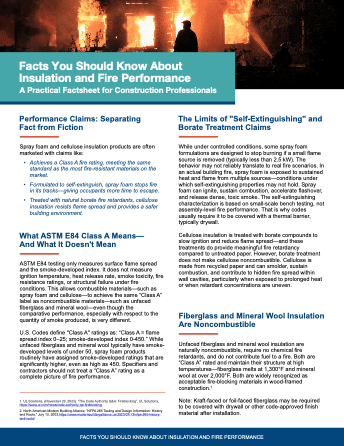
NAIMA has released a new fact sheet on common claims made by spray foam and cellulose insulation manufacturers. The fact sheet highlights three important considerations every builder and specifier should keep in mind.
1. A “Class A” rating is only one measure of fire performance. ASTM E84 evaluates flame spread and smoke development—not ignition, heat release, fire resistance, or how a product performs in a real building fire. Different materials can earn the same Class A rating while performing very differently under fire conditions.
2. Look beyond product claims. Terms like “self-extinguishing” or “borate treated” may describe limited laboratory conditions, but they don’t guarantee real-world fire behavior. Request assembly-level testing, including NFPA 285 and ASTM E119 where applicable.
3. Verify before you specify. Confirm smoke-developed index values, code-required thermal barriers, noncombustibility claims, and full assembly test documentation. Doing so helps reduce compliance risk while improving occupant safety.
To access the fact sheet, click here.