
How much does it really cost to build a home that uses dramatically less energy? According to a new analysis by ICF Consulting, the answer is surprisingly modest. A home built to the 2015 International Energy Conservation Code (IECC) uses roughly twenty percent less energy than a comparable home built to the 2009 code, while homes built to the latest 2024 IECC deliver even greater savings. Achieving those gains requires an upfront investment of only a few thousand dollars. In return, homeowners receive decades of lower utility bills and greater comfort. These long-term benefits stand in sharp contrast to claims by the National Association of Homebuilders that modern energy codes add tens of thousands of dollars to the cost of a new home. By measuring the cumulative costs of the prescriptive requirements in the 2015 and 2024 IECC, the analysis offers builders, policymakers, and homebuyers a detailed picture of what today’s energy codes actually cost.
The Study’s Methodology
One of the strengths of the ICF analysis is its transparent and comprehensive methodology. The study compiled incremental cost data for each prescriptive energy-efficiency improvement incorporated into the 2015 and 2024 IECCs from a broad range of industry sources. This data was used to develop low, median, and high cost estimates for every individual code improvement. The incremental costs were then aggregated to estimate the total cost of constructing a home that complies with each code edition. The ICF study examines the cumulative cost of all energy efficiency improvements adopted since the 2009 IECC, providing builders, policymakers, and homebuyers with a more meaningful assessment of what it actually costs to build a modern, energy-efficient home.
The Biggest Finding: 2024 IECC Requirements Increase Construction Costs
The report estimates the cost of compliance with the 2024 IECC (versus the 2009) at approximately $3,300 to $7,800 per home, depending on the climate zone, foundation type, and whether the home uses natural gas or electricity. Homes built to the 2015 IECC cost between $2,000 and $3,700 more than those built to the 2009 code.
The highest estimated costs occur in colder climates, where builders must install higher levels of insulation, better-performing windows, tighter building envelopes, and more.
The Numbers May Overstate Actual Builder Costs
One of the report’s key observations is that code compliance costs do not always match real-world builder costs. For example, the analysis assumes builders upgrade from an 80 AFUE gas furnace to a 95 AFUE furnace because that represents the federal minimum efficiency baseline. However, many builders already install 95 AFUE equipment as standard practice, effectively making the incremental cost of compliance $0 for that upgrade.
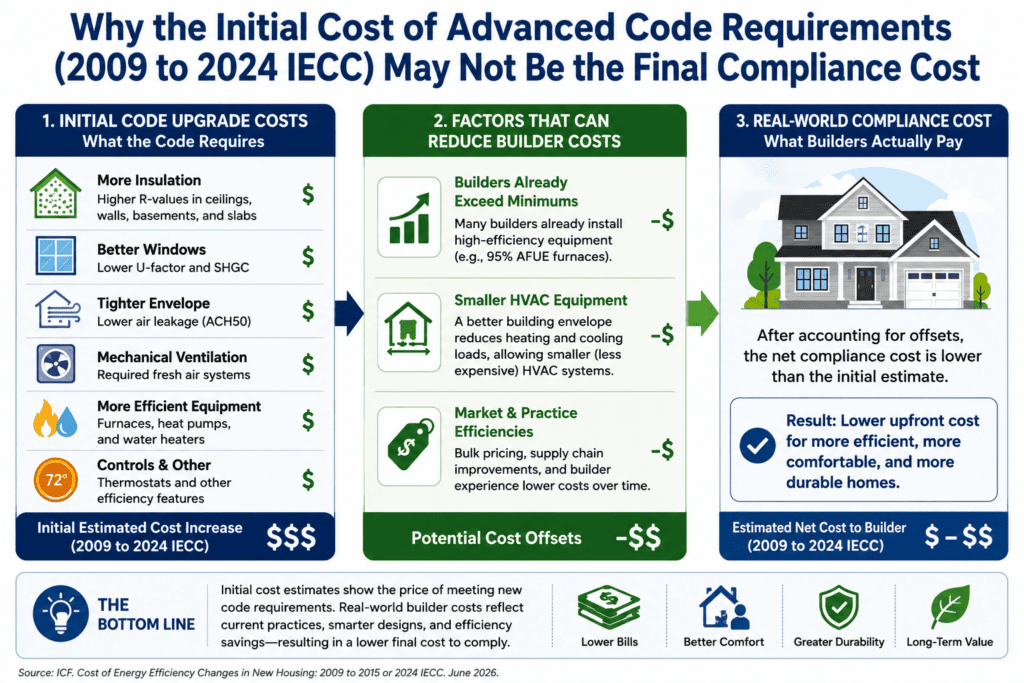
This is an important distinction because code impact studies are often cited in policy debates. Using theoretical baseline equipment rather than current market practice can exaggerate the perceived cost of adopting newer energy codes.
Better Homes Can Also Lower Equipment Costs
Notably, ICF’s report highlights a frequently overlooked benefit of improved thermal envelope construction enabled by advanced building codes: better building envelopes can reduce HVAC system size.
Improved insulation, tighter air sealing, and higher-performance windows reduce heating and cooling loads, allowing builders to install smaller air conditioners and heat pumps. And smaller HVAC equipment generally costs home builders less.
ICF’s analysis notes that downsizing HVAC equipment could offset hundreds – or even thousands of dollars of construction costs in some climate zones. Sample modeling showed potential HVAC savings ranging from roughly $400 to $4,700, depending on the climate zone and equipment type. These savings were not included in the report’s cost estimates, meaning that the actual cost of meeting new codes may be even lower than the ICF estimate.
The Bottom Line
A home built to the 2015 IECC is, on average, 20 percent more efficient than a home built to the 2009 IECC, while a home built to the 2024 IECC is nearly 40 percent more efficient. While building to a more modern energy code adds cost to new home construction, the ICF report shows that the real cost increase is modest, with other factors likely offsetting it. Many builders already exceed minimum equipment standards, and improvements to the building envelope can reduce HVAC sizing costs, partially offsetting the new requirements.
For the homebuilding industry, the big takeaway is that the real-world cost of energy codes requires a look beyond the initial price tag. As jurisdictions consider updating their energy codes, builders, manufacturers, and policymakers will benefit from considering not only compliance costs but also market practices, equipment trends, and the long-term value delivered by more energy-efficient homes.