
Residential Energy Services Network (RESNET®) recently announced an important milestone achievement: more than 5 million HERS-rated homes. It’s a massive number that reflects the organization’s momentum and impact on the energy-efficient homebuilding industry, but more than that, it’s a sign that builders and buyers value the energy performance rating, which is among the most recognized in the homebuilding industry.
This week, Insulation Institute delves into the HERS-score value proposition, why growth in HERS-rated homes should accelerate, and where the organization sees room to advance energy-efficient home building for a new generation of home buyers.
Steady Growth in HERS-Rated Homes Accelerated in 2025
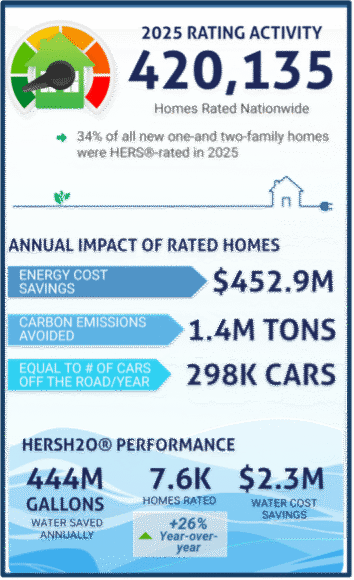
In 2025, more than 420,000 homes received a HERS rating – that represents 34 percent of all homes built last year. Over the past several years, the number of HERS-rated homes has grown consistently, leaping from more than 313,000 in 2021 to 362,000 in 2023. In that same time, the average HERS score for new homes has declined. In 2021, the average HERS score was 58; in 2023, it was 57, and in 2024, it dropped to 55. Last year, the average HERS Index score assigned to a home was 53, meaning that the average HERS-rated home was 47 percent more efficient than a home built as recently as 2006.
“Five million HERS-rated homes represent far more than a number,” said RESNET Executive Director Shelby Gatlin. It represents millions of families living in homes designed and independently verified to perform better.”
“At a time when housing affordability and rising utility costs matter more than ever, the HERS index helps provide confidence that a home’s energy performance has been measured and verified by a qualified third party.”
Collectively, the growth in HERS-scored homes has major impacts for homeowners, with last year’s accumulated energy cost savings estimated at $452.9 million. Furthermore, the improved energy performance of these homes helped reduce carbon emissions of 1.4 million tons – the equivalent of removing 298,000 cars from the roads.
RESNET’S H2O Performance Rating Also Sees Impressive Growth
It’s not just in energy performance where RESNET is seeing impressive growth – its whole-house water-efficiency rating system, HERSH2O®, increased by 26 percent year-over-year. The resulting benefits include saving a combined 444 million gallons of water, resulting in $2.3 million in cost savings for the 7,600 rated homes.
Why It Matters
As we previously reported, 61 percent of home builders see energy cost as among the factors that could drag down housing demand this year. With energy costs burdening an increasing number of American families and concerns over water usage and availability growing, RESNET’s presence in the efficient home building market should only strengthen in the future.
“Five million HERS-rated homes demonstrate that builders and homebuyers increasingly recognize the value of independently verified performance,” said RESNET Executive Director Shelby Gatlin. “As energy affordability, resilience, and resource efficiency become even more important, we believe the next five million homes will come even faster.”